|
Symphony
FROM THE NEW WORLD TO THE OLD WORLD
by Peter Lert
Saturday, June 14, 2025
Chamber
MC2 DUO RECITAL CLOSES 222'S SEASON
by Terry McNeill
Saturday, June 14, 2025
Choral and Vocal
CANTIAMO SONOMA'S LUSCIOUS A CAPELLA SINGING IN SEASON ENDING CONCERT
by Pamela Hicks Gailey
Sunday, June 8, 2025
Symphony
SRS SEASON ENDS WITH RESOUNDING TA-TA-TA-BANG
by Terry McNeill
Sunday, June 1, 2025
Symphony
YOUTHFUL VIRTUOSITY ON DISPLAY AT USO'S MAY CONCERTS
by Peter Lert
Saturday, May 17, 2025
Symphony
MYSTICAL PLANETS AND LIVELY GERSHWIN ORTIZ AT FINAL SRS CONCERT
by Peter Lert
Sunday, May 4, 2025
Symphony
VSO'S CONCERT MUSIC OF TIME, MUSIC OF PLACE
by Peter Lert
Sunday, April 27, 2025
VOCAL ELEGANCE AND FIRE AT THE 222'S RECITAL APRIL 26
by Pamela Hicks Gailey
Saturday, April 26, 2025
CANTIAMO SONOMA SINGS AN INSPIRED GOOD FRIDAY MOZART REQUIEM CONCERT
by Pamela Hicks Gailey
Friday, April 18, 2025
DRAMATIC SHOSTAKOVICH SYMPHONY CLOSES PHILHARMONIC'S 25TH SEASON
by Terry McNeill
Sunday, April 13, 2025
|
 |
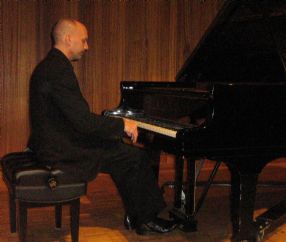 Paul Barnes Playing Glass' Orphée Suite March 18 |
BARNES CHAMPIONS PHILIP GLASS AND ARVO PART WORKS IN CONCERTS GRAND RECITAL
by John Metz
Sunday, March 18, 2012
Paul Barnes began his March 18 Concerts Grand piano recital with an ominously resounding low B double-octave, thus transporting his audience into the dreamy and introspective world of Arvo Pärt’s Für Alina. After playing this octave, which resonates by the use of the sostenusto pedal for the duration of the piece, the music takes on a more crystalline tone quality, consisting of each hand playing single notes in equal rhythms, both in the piano’s treble register. The piece is remarkably simple, and the left hand’s notes consist of nothing more than a basic B minor triad, and the right hand’s notes outline a ruminating, meditative, and peaceful melody. Yet the work’s simplicity is the very reason it takes a true artist to make it work. In each tiny phrase of Für Alina one must see more than just white and black keys, past any semblance of simplicity, and into something deeper. There is no clearly defined rhythm, and the whole piece is performed with careful rubato. This is what gives it its introspective character.
Für Alina unfolds as though Mr. Barnes was experimenting at the piano and exploring the instrument’s qualities. Some might choose to play it with the most delicate pianissimo touch, allowing each note not so much to resonate, but rather to melt, one into the next. Another performer may choose to play with a more glassy tone, giving each note its full value and attention, allowing the dissonances to cry rather than to hum, and giving the entire piece an added degree of clarity. The latter is the approach Mr. Barnes took.
Without pause, he moved into Siloti’s transcription of Bach’s B minor Prelude, creatively establishing a link between Pärt and Bach, a connection that Alasdair Neale and the Marin Symphony explored only weeks ago in their most recent program at the Marin Center. And given the context, it makes sense that Barnes would perform Für Alina with a touch of Baroque clarity. In Siloti’s transcription the tenor line is given a melody, thus resulting in a very multidimensional work: bass, harmony, tenor melody, and right hand running sixteenths. One audience member later commented that it was as though she were looking into a pond on a sunny day, able to see clearly all the pebbles, rocks, plants, and whatever else lie beneath the surface. This was the perfect imagery to describe what Mr. Barnes’ playing evoked.
Next came the first of many works on the program by the well-known minimalist composer Philip Glass. Barnes explained that the multitude of Glass works he had programmed were the result of his friendship with the composer. Glass’ Trilogy Sonata was transcribed by Michael Riesman and edited by Mr. Barnes. There are three movements, each inspired by a scene from Glass’s opera trilogy of Einstein on the Beach, Satyagraha, and Akhnaten. First came the second movement, Act III Conclusion, from Satyagraha, and in typical Glass style it is based on simple and repetitive harmonic progressions, which cycle over and over throughout the piece. Emerging from this basic harmonic progression was the most lovely left hand melody, a simple rising scale which sounded like a cello in the hands of Mr. Barnes. Whereas the second movement was serene, the third movement, Dance from Act II Scene III of Akhnaten, was riveting. The basic texture is a trill in the right hand over a jumpy bass, and the work goes back and forth from this texture into more purely coloristic harmonic sections. I have a feeling these opera transcriptions may not translate particularly well to the piano, as both movements, particularly the third, seemed to give Barnes technical troubles.
The highlight of the afternoon was the Monstré Sacré by N. Lincoln Hanks. The Pepperdine University composer was in the audience and introduced the work with pithy comments. Monstré Sacré means “holy terror” and describes the unconventional, strange, and perhaps even vile artist who, despite his peculiarities and horrific personal habits, remains revered by the public and seems always to be forgiven. The first movement, Entrée et intrus (Entry and intruder), was impulsive, unpredictable, and exciting. The second movement, Jeux et théorie: connexion libre avec Bach, was a dreamlike reminiscence on the music of Bach, which in true Postmodern style is built almost entirely from quotations of the great master, most notably the Gigue from his G major French Suite. The third movement, Parfait amour (Perfect love), was sensual and more melodically oriented than the first two movements, and had features of a jazz ballad. The fourth movement, Rondeau et sortie: le monstre danse, was reminiscent of Prokofiev in its robustness, yet contained jazzier moments that might remind one of Gershwin, all the while containing frequent Romantic flourishes up and down the piano. A brief reflective interlude leads into a husky Prokofiev ending. Mr. Barnes, using a score, gave a fantastic performance of this work by Mr. Hanks.
Glass’ opera Orphée was inspired by Cocteau’s film of the same name and in 2000 Mr. Barnes transcribed selected movements of the opera into a piano suite. Much of Glass’s music is inspired by music from the original film, most of which was composed by Georges Auric, a fellow member of the French group of composers Le Six. The first movement, The Café, is a rag. One thinks here that Joplin meets Glass. This was an enjoyable performance but I found that Barnes’s playing became clumsier and less focused as the movement progressed. The reflective and dreamy second movement, Orphée’s Bedroom, was inspired by music from Gluck’s ballet Orfeo et Euridice, which plays a crucial role in Cocteau’s film. The third movement, Journey to the Underworld, introduces an ominous bass theme that appears in later movements. And the fourth movement, Orphée and the Princess, introduces a new four-chord harmonic progression that was deserving of the frequent repetition it received. This progression was accompanied by a soaring scalar melody, perhaps the most beautiful of the entire set. Later movements essentially contained material drawn from or directly repeated from earlier movements, with a reprise of Orphée and the Princess serving as the work’s dénouement.
Barnes closed the recital with his arrangement of the third movement from Glass’s Piano Concerto No. 2, “The Land," depicting the 19th-Century Lewis and Clark Expedition. The movement was a theme and variations, a musical form that lends credence to repetitiveness, and thus a form a composer who is already preoccupied with repetition might want to steer clear of. Mr. Barnes played his own cadenza to the work, a pianistic challenge for him. There was one one encore, another work by Phillip Glass called Monsters Of Grace, from a forgotten 1998 chamber opera of the same name with libretto by a 13th Century Sufi mystic.
Mr. Barnes is a personable and well-schooled pianist and speaks charmingly to the audience between pieces, offering introductions to the works. But a program so rife with Glass is certainly a gamble with many listeners really loving the music and others finding the repetitions irritating and verbose. Though one audience member who did not particularly enjoy the insistent repeats of the Glass claimed to have loved the Pärt, who himself is often described as a “sacred minimalist.” Other listeners suggested that Glass’s music is good but doesn’t hold its own very well, more like movie music than concert music.
In the end, love it or hate it, everyone walked away from Newman Auditorium wiser.
|

